What is MRAM?
MRAM (Magnetic RAM) is a memory technology that uses electron spin to store information (an MRAM device is a Spintronics device). MRAM has the potential to become a universal memory - able to combine the densities of storage memory with the speed of SRAM, all the while being non-volatile and power efficient.
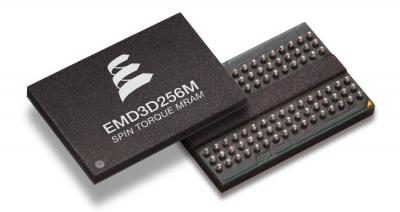
MRAM technology is still far from realizing its potential, but today there are MRAM chips available on the market ranging from very small ones to 1Gb chips, and companies are adopting this technology for many applications - in a wide range of industries including autmotive, space, data centres, and more.
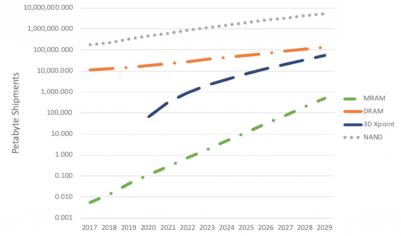
Dozens of companies and research groups are developing next-generation MRAM technologies as analysts expect MRAM shipments and revenues to grow quickly in the next few years. Objective Analysis and Coughlin Associates for example expects that stand-alone MRAM and STT-MRAM revenues will grow 170X from 2018 to 2029 (with shipments accelerating as prices continue to decrease).
MRAM can resist high radiation, can operate in extreme temperature conditions, and can be tamper resistant. This makes MRAM suitable for automotive, industrial, military and space applications, and these are important segments for MRAM developers.
Types of MRAM memory devices
The first MRAM devices to be realized used toggle memory switching, in which a magnetic field is used to change the electron spin. Toggle MRAM was easier to develop, and toggle MRAM chips started shipping in 2006.
Toggle MRAM however was difficult to scale up (current chips are limited to 32 Mb), and second-generation MRAM devices use a different architecture that uses a spin-polarized current to switch the spin of electrons. So-called STT-MRAM devices are faster, more efficient and easier to scale-up compared to toggle MRAM. STT-MRAM chips are now shipping on the market with densities of up to 1 Gb. Many consider SOT-MRAM (spin-orbit torque MRAM) to have the potential to challenge and overtake STT-MRAM, as it is a faster, denser and much more efficient memory technology.
The MRAM market
In July 2006, Freescale started to sell the world's first commercial MRAM chip. Those chips had a low capacity of 4Mbit and the price was set at $25.
Freescale's MRAM division was spun-off into a new company called Everspin, considered to be the leader in MRAM technologies. Everspin is now shipping both Toggle-MRAM and STT-MRAM chips, up to 1Gb in size. Since its establishment, Everspin shipped hundreds of millions of MRAM chipset. Everspin's partner, GlobalFoundries, started to offer embedded MRAM solutions in early 2020, with first customer tape-outs expected by the end of 2020.
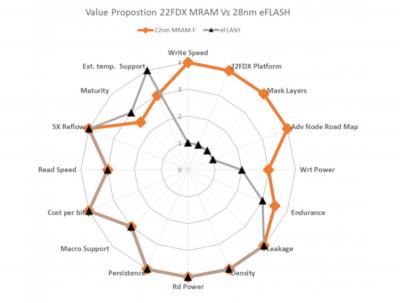
Many companies are also developing and starting to produce MRAM chips or to offer embedded MRAM solutions,, including IBM and Samsung, Toshiba, Everspin, Avalanche Technologies, and others.