 Seagate is one of the world's leading Hard-Disk makers.
In 2008 Seagate's CEO said that the company is developing a next-generation memory technology - something similar to MRAM or Phase-Change memory. Seagate is collaborating with Everspin - in 2017 the company demonstrated an MRAM-powered high performance SSD boot drive and in 2018 the company executed a licensing agreement with Everspin.
10200 De Anza Blvd
Cupertino, CA
United States
Everspin and Seagate announce an IP patent assignment and licensing agreement
Everspin Technologies announced that it has signed an IP cross-licensing agreement with Seagate Technology. Everspin will license specific Tunneling Magnetoresistance (TMR) patents to Seagate, while Seagate will license MRAM patents to Everspin.
Everspin says its IP portfolio is now stronger which will provide further protection to for its products and services, while Seagate will gain license to TMR IP which can be used in HDD head technology.


Seagate demonstrate an MRAM-powered high performance SSD boot drive
Seagate demonstrate several new prototypes and technologies at Flash Memory Summit last week, and one of these is the new Nytron 5000B SSD drive that is a high-performance boot drive. The new device has 256GB of 3D MLC NAND and makes use of 1258MB of Everspin's STT-MRAM in addition to a "normal" DRAM cache.
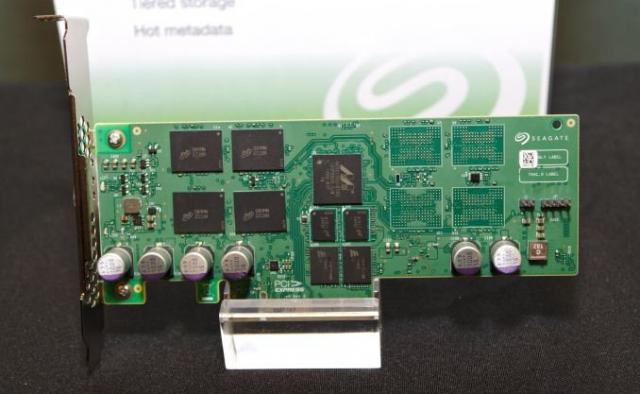
Seagate says that the MRAM can be used as either a write cache for user data or it can be exposed directly as a separate storage namespace for explicit tiered storage. Seagate said that this is currently just a test-platform prototype - and not a preview of an upcoming product.
Seagate CEO sees MRAM as a competitor for DRAM and not H/D
Seagate's CEO talks again about MRAM (last month he said they are putting a lot of money into next-gen memory tech, including MRAM). He says that MRAM will be a competitor for DRAM and not H/D.
Via VentureBeat
Seagate: We're putting a lot of money on next-gen memory technologies
 Seagate's CEO, Bill Watkins, said that the company is investing "a lot of money" into what the company thinks will be the next-generation memory technology after MLC.
Bill says that the technology "would be something like a spin around magnetic RAM, it could be a phase shift type of process. I won't go into [details] because it's kind of proprietary". The company is looking at several technology, and says it will not develop flash products as it "doesn't pay".

