 Applied Materials is developing and marketing equipment, services and software for manufacturing of semiconductors, displays and PV products.
In July 2019 Applied Materials launched its Endura Clover MRAM PVD platform for MRAM mass production.
3050 Bowers Avenue
Santa Clara, CA 95054-3299
United States
Taiwan's Semiconductor Research Institute developed an SOT-MRAM device based on a PMA technique
Researchers at Taiwan's Semiconductor Research Institute (TSRI) unveiled a new SOT-MRAM memory device that they developed in collaboration with University scientists.
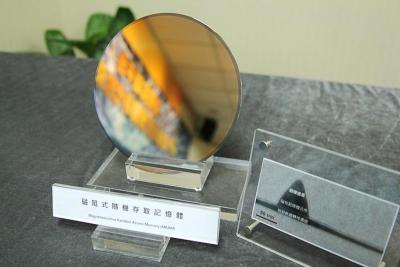
The new device uses a perpendicular magnetic anisotropy (PMA) technique. According to the TSRI researchers, they are the second team to successfully produce MRAM chips based on PMA (Intel is the first team to have achieved this).


Spin Memory raised $8.3 million as it extends its Series B Funding Round
 Spin Memory (previously Spin Transfer Technologies) announced that it has raised $8.3 million in an extension to its Series B funding. The company's recent investors in the company participated in this round, out of which Allied Minds invested $4 million.
The new funding includes Arm, Applied Ventures (the VC arm of Applied Materials) and Abies Ventures. Spin Memory says that the additional funding will support the company's MRAM R&D.
The 2019 MRAM Developer Day will feature 1Gb MRAM parts and AI Applications
The 2019 MRAM Developer Day will be held on August 5th at the Santa Clara Convention Center (co-located
with Flash Memory Summit), and will center around Everspin's 1Gb MRAM part now in production.
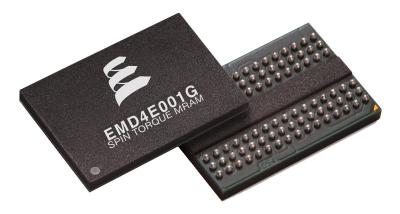
Keynotes from Everspin, Tokyo Electron, and Applied Materials will focus on MRAM as a disruptive technology and on new manufacturing tools and processes for STT-MRAM. Plenary sessions will cover the current state of MRAM technology and MRAM markets and future trends through 2025, while breakout sessions will cover applications briefs, embedded MRAM, development, and AI applications.
Applied Materials unveils new high-volume 300mm MRAM manufacturing system
Applied Materials unveiled new high-volume manufacturing solutions for next-generation memories. The Endura platform integrates multiple materials engineering technologies along with on-board metrology to create new films and structures.

Applied’s new Endura Clover MRAM PVD platform is made up of nine unique wafer processing chambers all integrated in pristine, high-vacuum conditions. Applied says that this is the industry's first 300-millimeter MRAM system for high-volume manufacturing capable of individually depositing up to five different materials per chamber. The Clover MRAM PVD platform includes on-board metrology that measures and monitors the thickness of the MRAM layers with sub-angstrom sensitivity as they are created to ensure atomic-level uniformity.
MRAM Developer Day proceedings posted online
The MRAM Developer Day 2018 took place on August 6th, as part of this year's Flash Memory Summit. This seemed to have been an interesting event, with presentations from Everspin, GlobalFoundries, IBM, Applied Materials, Spin Transfer Technologies and more.
Yole sees STT-MRAM as the most suitable technology to start replacing DRAM in 2018
Yole Developpement released a new emerging-memory market report in which they try to asses the future of the memory market. Yose says that Phase-change memory (PCM) is pretty much dead, and the two main emerging memory technologies are MRAM and Resistive random Access Memory (ReRAM or RRAM).

While RRAM is very promising in the near future, with support from Micron (they plan to release RRAM chips in 2015) and Panasonic while other players are expected to react quickly. RRAM and STT-MRAM will compete in 2015-2016 in some standalone markets (such as embedded MCU, wearables and smart cards and the storage class memory for enterprise storage which will be the biggest market), and it's not clear yet which technology will be the most popular.
20 chipmakers from Japan and US to co-develop MRAM in hopes to replace DRAM within 3 years
According to Nikkei, over 20 Japanese and US companies have teamed up to develop MRAM technologies, in particular a new mass production method. Participants in this ambitious project include Tokyo Electron (who's merging with Applied Materials), Renasas, Hitachi and Shin-Etsu Chemical from Japan and Micron Technology from the US.
Japan's Tohoku University, a leader in Spintronics and MRAM research, will also join the project. The companies will finance several dozens researchers at the University. They plan to start development in February 2014, and continue to seek more companies from the US and Europe to join. The aim is to complete materials and processes development by 2017 and start mass production by 2018.

